Natsujiro shoten and Koginsashi | 01
Have you heard of Koginshi embroidery, a representative folk art of Aomori?
I didn't know that much.
Recent Kogin embroidery is stylish and cute.
With Natsujiro Shoten, the pioneer who created this "recent" trend
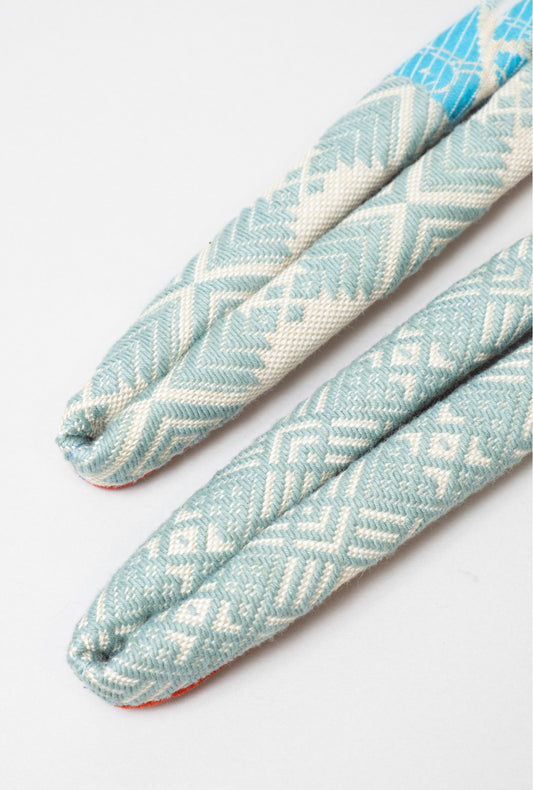
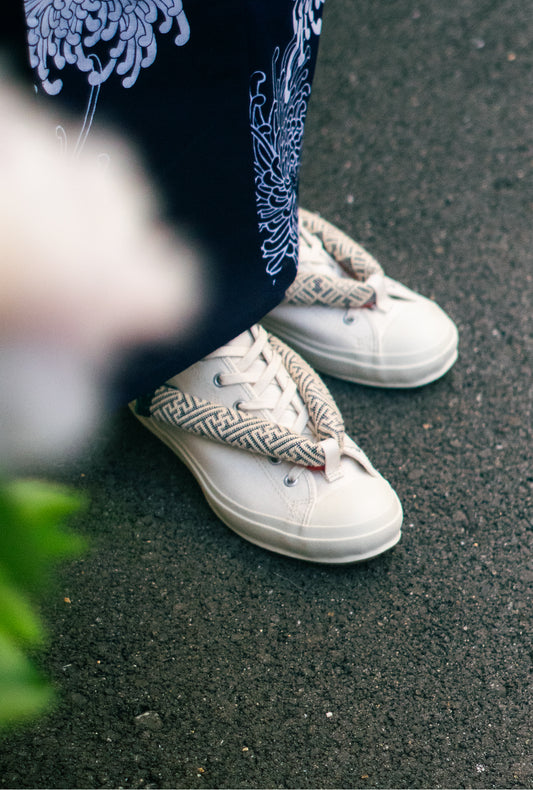
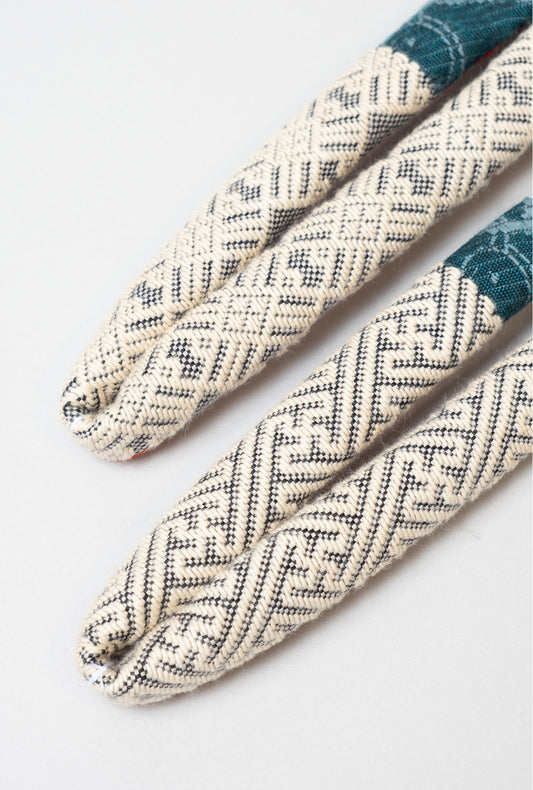
WLK's HANAO SHOES collaboration
So, I took this opportunity to go to Aomori.
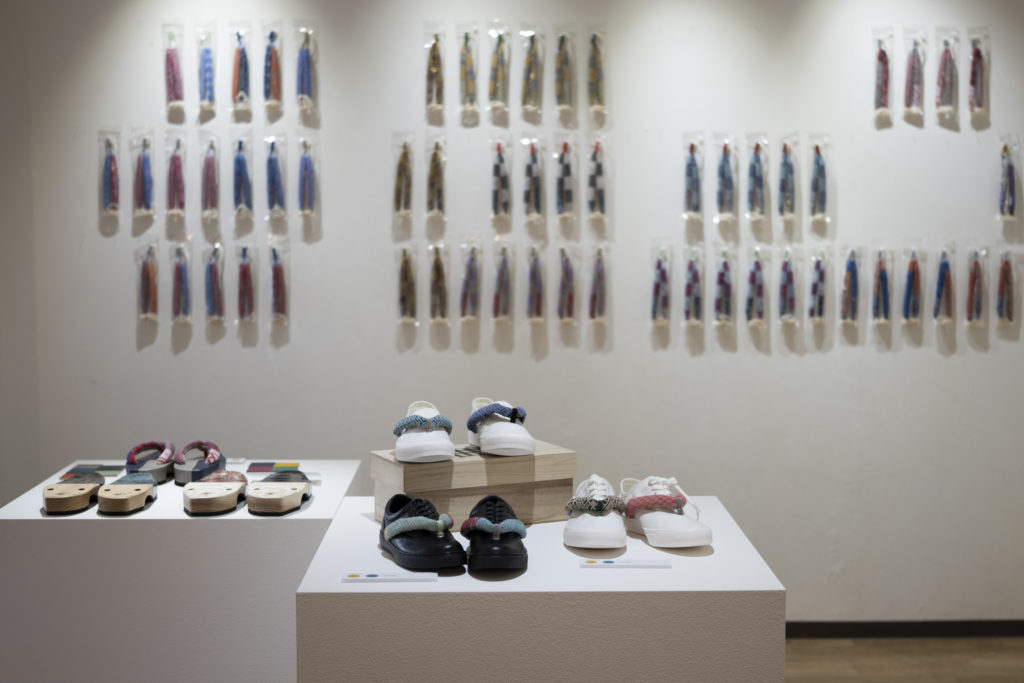
A project to attach Natsujiro's Kogin embroidered thongs to HANAO SHOES.
The venue is Gallery CASAICO in Hirosaki City.
It was cold, but it was worth the trip.
With Koginzashi artist Natsujiro (photos not allowed)
I will post the transcript of the talk here.
About Hirosaki, Kogin embroidery, Aomori's traditional industries, etc.
Natsujiro Shoten and Kogin Embroidery | 01
Learn "Koginzashi" at home in Aomori
Basic knowledge: The roots of Kogin embroidery.
It was a time when people would say, "This isn't Kogin embroidery."
Natsujiro Shoten and Kogin Embroidery | 02
After all, anyone can do embroidery.
Because it is made by specialists working together in a division of labor, added value can be added.
The reason for the thong and Natsujiro.
Natsujiro Shoten and Kogin Embroidery | 03
I didn't know about HAMAO SHOES.
After the talk with Natsujiro
Learn "Koginzashi" at home in Aomori
Sakai:
In Aomori, people learn Kogin embroidery at home.
Natsujiro:
Yes, I learned it in home economics class in high school. Everyone learns it at least once in school as part of a craft class.
Sakai:
High school instead of middle school?
Natsujiro:
High school.
Sakai:
It seems like you're not good with boys, what do you think?
Natsujiro:
No, not that far. I can memorize it in a day, and it's easy to learn one point.
Once embroidered, the craftsman will make it into a coaster etc. Even if you're not interested, it only takes a moment.
Sakai:
Do you also learn Tsugaru lacquerware (another traditional Aomori industry)?
Natsujiro:
There are no courses on "Tsugaru lacquerware."
However, everyone's home always has a Tsugaru lacquer bowl, tray, or chopsticks.
Sakai:
I also have chopsticks.
Natsujiro:
Is it Tsugaru lacquerware?
In my life, I have never used anything other than Tsugaru lacquerware.


Sakai:
cool.
Natsujiro:
It has a distinctive marble pattern, and it's a paint job that people either love or hate.
Sakai:
Aomori's local industries are Tsugaru lacquerware and Kogin embroidery...
Natsujiro:
What else is there, like cypress?
Sakai:
Right, cypress.
Natsujiro:
If you go to Kuroishi, you can also find kokeshi dolls being made.
Sakai:
Kokeshi dolls. Among them, the one you learn in high school is "Koginzashi." Maybe it's because it's easy.
Natsujiro:
I think so.
Sakai:
Natsujiro only did it once in high school.
Even though I only did it once, it has now become my job.
Natsujiro:
Well, yes. I guess it was fun.
Sakai:
It was only one day, but I remember it.
Natsujiro:
Soon after that class, I started another one.
I made something like a Kogin embroidery stamp case to give as a gift to a friend.
Sakai:
I want that too.
Natsujiro:
I wonder if there's a processing plant.
In the past, there were many processing factories in the city that would make accessories if you had any fabric.
The one in Aomori City has fallen into disuse and no longer exists,
Hirosaki places great importance on crafts, so there may still be some left.
Sakai:
Please tell us a specific example of how you "cherish crafts."
Natsujiro:
Nowadays, everyone can easily make Kogin embroidery,
10-20 years ago, the traditional "navy blue dyed linen fabric with off-white thread" was really the basic style, and there was a feeling that this was the only "Kogin" style.
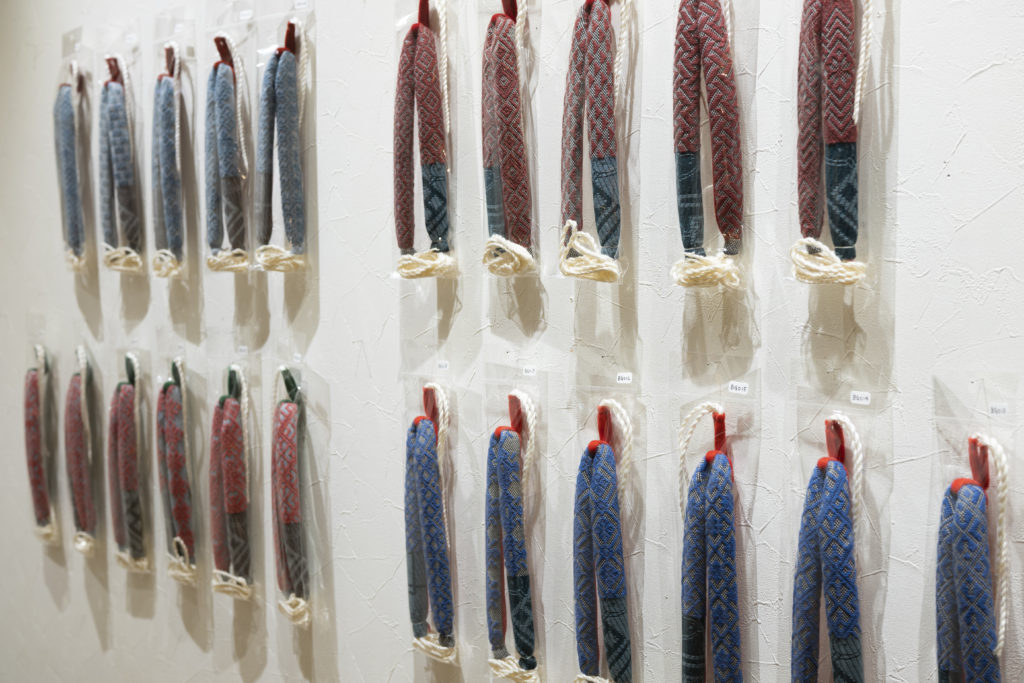
But now things are changing rapidly, and even in Hirosaki, shops are exhibiting and selling red and blue "Koginzashi" accessories,
I embroider lines on scarves and shirts.
This new "Kogin" style is very popular in Hirosaki, and there are many stylish Kogin embroideries.
Sakai:
Rather than preserving traditions, they develop them, have fun with them, and cherish them.
Basic knowledge: The roots of Kogin embroidery.

Sakai:
Is the classic off-white silk Kogin no longer available?
Natsujiro:
There are craftsmen who continue to make them.
The navy blue linen is called "karamushi" and is very valuable. There aren't many people who make karamushi, though.
Sakai:
Caterpillar?
Natsujiro:
"Karamushi" refers to a type of karamushi fabric made from thread spun from the "imoma" plant, a member of the nettle family, and indigo-dyed karamushi fabric has long been used for Kogin embroidery.
In the past, farmers were only allowed to wear linen as a policy. In winter, it was so cold that they would die, so they would keep warm by stitching undyed off-white thread into the linen fabric.
The first thing they did was make work clothes like that. Even now, there are people who cherish the colors, textures, and materials of that time.
Sakai:
It means making it thicker by using Kogin stitching.
So, since it was not enough to just embroider, the origins of Kogin embroidery came from adding stylish geometric patterns.
But nowadays, there are plenty of warm clothes available so you don't have to go out of your way to do that.
I wonder what kind of person would buy it.
Natsujiro:
Of course, it's not used as work clothes,
It gradually becomes smaller, like a table.
Sakai:
I see.
Natsujiro:
They've moved beyond just clothing to include coasters and placemats.
The scale was once reduced, but now the number of colors has increased rapidly, and we now offer cushion covers, bed covers, scarves, hats, etc.
It seems like the number of items is increasing and the range of things people wear is expanding.
It seems that craftsmanship has not yet completely broken away from the category of easy crafts, partly because of the popularity of classes and the like.
Sakai:
I see.
Basic "Kogin embroidery" with navy blue and off-white thread.
To Natsujiro, people who have been doing this for a long time are like the "mainstream" in the world of Kogin embroidery.
Natsujiro:
I think it's mainstream.
Sakai:
That's what happens.
Currently, there is a movement to use various colors and learn in classes. The culture of "Kogin embroidery" is spreading.
In that case, do you have any acquaintances in the "mainstream" world?
Natsujiro:
No, I only learned it in high school.
There are four or five great teachers scattered around the country, but I don't study under any of them.
People who are knowledgeable about "Koginzashi" come to the exhibition and often ask me "Where did you study at and under whom did you learn?"
I'm mostly self-taught, so I'm not sure if I'm following tradition.
Sakai:
Yes, yes. But if you study under a great master, it's a bit much to say that you're following his example.
Natsujiro:
I think it's a sign of prestige, like he's attached to a great teacher.
But I think it's also important to learn.
Sakai:
That's right. I'm sure the teacher is conveying to his students the scenery he has seen.
So, going back to the topic for a moment, did you learn Kogin embroidery in high school, make embroidery for your friends, and continue doing it ever since?
Natsujiro:
There was a short gap. When I left Aomori to get married, I wonder what happened.
Sakai:
Where did you go?
Natsujiro:
First up is Sendai.
So, what is it... to put it simply, I felt like I wanted to be in touch with local things,
I thought I might try my hand at Kogin embroidery, which I used to love.
As I continued doing it, it gradually became more fun, so I decided to put more effort into it.
So, it got to the point where we thought it might sell.
It was a time when people would say, "This isn't Kogin embroidery."
Natsujiro:
At first, I didn't sell it, I just used it myself.
I don't know where to sell it
When I started, the mainstream Hontsugaru Kogin embroidery was still the mainstream, so I thought, "This isn't Kogin embroidery."
"It's not this color."
"These kinds of small items..."
That was the era.
It's completely different now though.
Sakai:
How many years ago was that?
Natsujiro:
It started in 2012.
At that time, the world was still closed off, so when I brought it to Aomori, people said things like, "This isn't Kogin embroidery."
Furthermore, I'm from Aomori City, not Hirosaki, so they say things like, "Your is a little different."
Sakai:
Hold on, a question.
Is "Koginzashi" a Hirosaki specialty?
Natsujiro:
Hirosaki is like that too, but Aomori City is different.
Kogin embroidery has three birthplaces, each with a slightly different way of making it.
There is a type called "Mishima Kogin" that has three lines on the shoulders, and the patterns vary depending on the region, and Hirosaki is one of them.
Sakai:
All of Aomori Prefecture?
Natsujiro:
It's in Aomori Prefecture.
But Aomori City is different.
When we first started, there was a time when people thought, "If it's made by someone from Aomori City, it can't be real Kogin."
Sakai:
I see.
Natsujiro:
It was very difficult.
So I decided to move away from Aomori for a bit and started exhibiting at a craft event that is held once a year in Tokyo.
I was doing general merchandise there for a few years, but at that time "Koginzashi" was not related to Aomori City or Hirosaki,
It has become an easy craft that everyone can enjoy, regardless of whether it is mainstream or not.
Sakai:
It has changed.
Natsujiro:
It changed, and the writers became saturated, so I just did the thong.
Sakai:
! I just fast-forwarded a lot.
When Natsujiro started doing Kogin embroidery in various colors,
Natsujiro:
There was no one like that.
Sakai:
It's a revolution, after all.
Natsujiro:
Well, what do you think?
Sakai:
A small revolution, far away from Aomori.
Continued in 02
Natsujiro Shoten Instagram:
@kogin_natsujirou
Gallery CASAICO Instagram:
@casai